
Chawri Bazar collapse: MCD suspends engineers; narrow lanes slow rescue
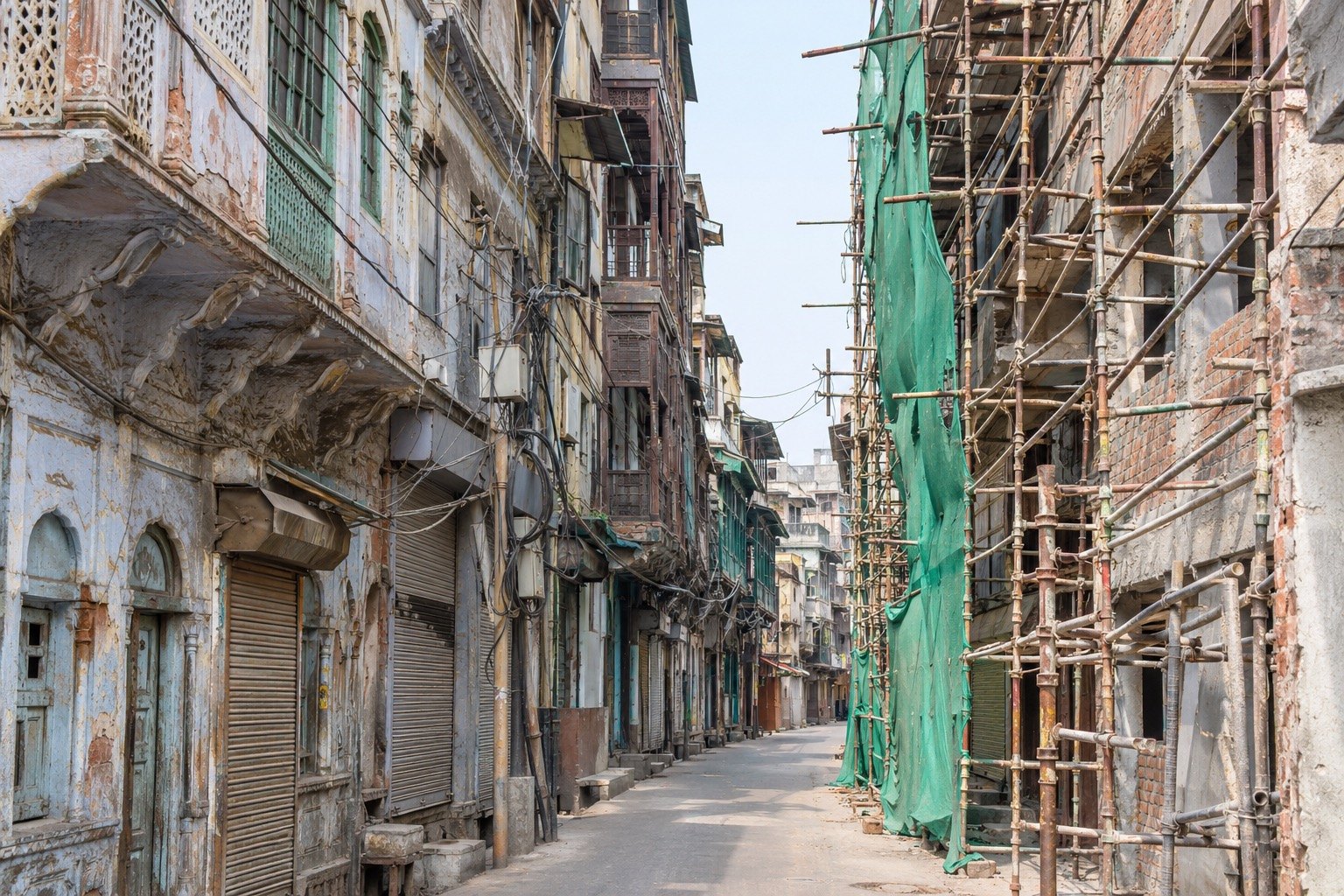
A three-storey building under construction collapsed near Old Delhi's Chawri Bazar on 5 November 2026; six workers were dead by 7 November. The Delhi Police had told the Municipal Corporation of Delhi (MCD) in June that it was being built illegally. The MCD has suspended two engineers. Lanes four to five feet wide kept earthmovers out of the rescue.
Syllabus: GS1 · Women, Population & Urbanisation; GS2 · Governance & e-Governance; GS3 · Disaster Management
Why this matters for UPSC
GS3 disaster management and GS2 urban governance: building-rule enforcement and collapsed-structure rescue. Prelims can ask what the NDMA's earthquake guidelines say on rescue and bye-laws; Mains, municipal accountability.
Why it matters
A labourer on a building site in a crowded market relies on two safeguards. One is a civic check that stops unsafe or illegal work before it goes too far. The other is a rescue team that can reach him quickly if the structure falls. When a lane is too narrow for machines, rescuers must clear debris slowly and carefully, and anyone still trapped waits longer for help. When illegal building is flagged but not stopped, the cost falls on the workers inside and the families next door, not on those who skipped the rules. The case also shows why the first minutes belong to neighbours, who pulled workers out soon after the collapse.
Prelims pointers
- The NDMA's 2007 earthquake guidelines ask State governments to review town and country planning Acts, zoning regulations and building bye-laws at least once every five years.
- Under those guidelines, all professionals dealing with the safety aspects of buildings and structures are to be certified through a licensing process.
- The guidelines record that over 80% of search and rescue from collapsed buildings is done by the local community before state machinery and specialised teams arrive.
- NDRF battalions are to help State and district authorities train community rescue teams, assisted by Civil Defence, Home Guards, fire services and NGOs.
- The ICS runs response at the site under the local administration; an Emergency Operation Centre (EOC), set up by the State, coordinates people, relief supplies and equipment.
- BNS Section 105 covers culpable homicide not amounting to murder; Section 290 covers negligent conduct in constructing or repairing buildings.
- The NDRF can be sent to a building collapse on a State government's request, as in Chennai in April 2023 on Tamil Nadu's request.
- State governments are to list debris-clearing and rescue equipment, identify its suppliers and sign long-term agreements for its deployment after an earthquake.
Practise a UPSC-style question
With reference to the National Disaster Management Guidelines on the management of earthquakes (2007), consider the following statements:
1. The Central government is to review building bye-laws and zoning regulations at least once every five years.
2. Professionals dealing with the safety aspects of buildings are to be certified through a licensing process.
3. State governments are to amend urban regulations to add multi-hazard safety requirements.
Which of the statements given above is/are correct?
- (a) 1 and 2 only
- (b) 2 and 3 only
- (c) 1 and 3 only
- (d) 1, 2 and 3
Show the answer
Answer: (b) 2 and 3 only
Answer: (b) 2 and 3 only. The guidelines give the five-year review to State governments, not the Centre.
Statement 1: incorrect. The NDMA's 2007 earthquake guidelines ask State governments to review planning Acts, zoning regulations and building bye-laws at least once every five years.
Statement 2: correct. All professionals dealing with the safety of buildings and structures are to be certified through a licensing process.
Statement 3: correct. State governments are to update urban regulations by adding multi-hazard safety requirements.
Eliminate: Statement 1 names the Centre for a task the guidelines give the States. Out: (a), (c), (d).
Trap: Swapped attribution. A real five-year review duty is pinned on the Central government instead of the State governments.
Remember: States, not the Centre, revise building bye-laws at least every five years under the NDMA's earthquake guidelines.