
Centre declares Bihar's Ranivas Mound of national importance under AMASR Act
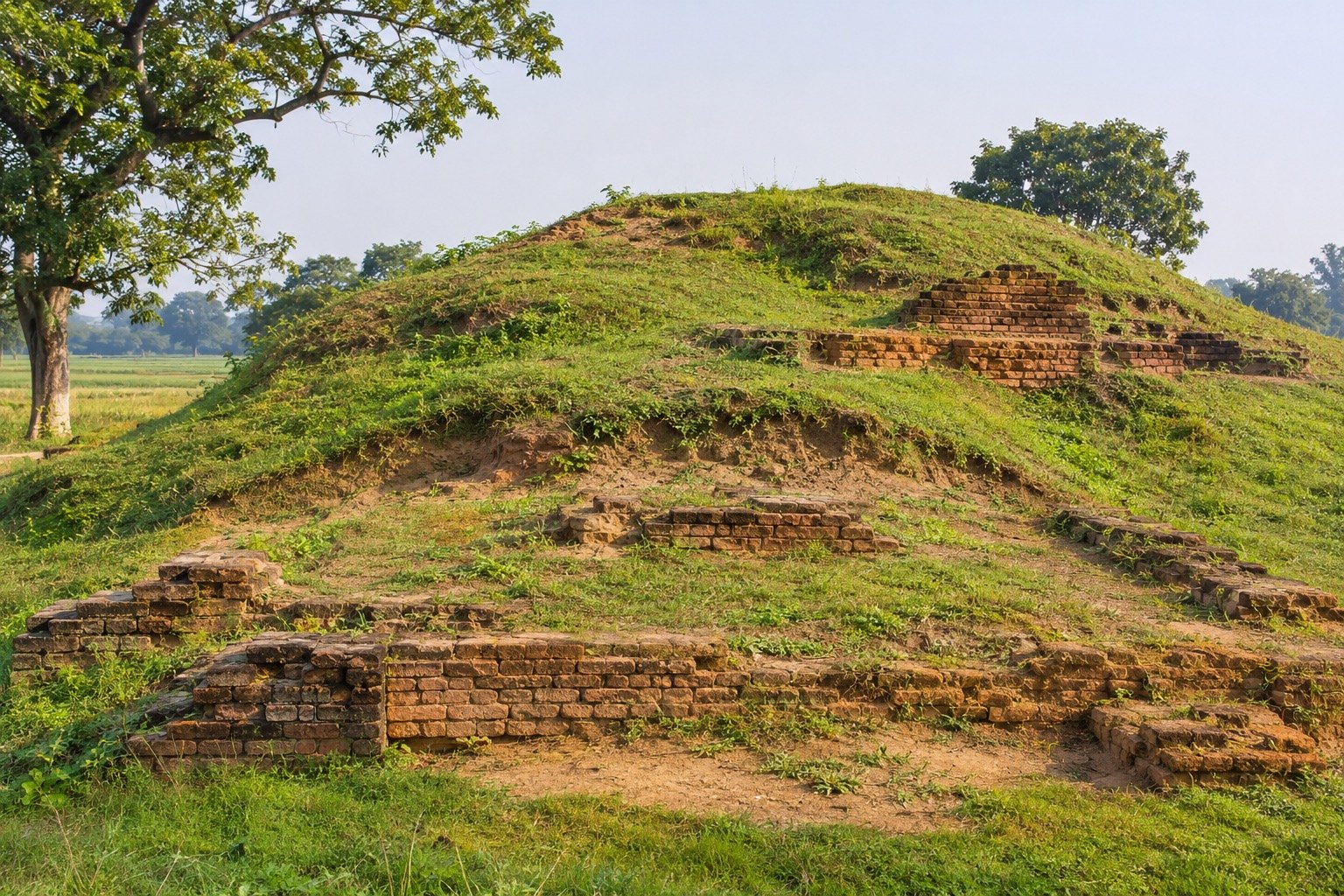
The Centre has notified the Ranivas Mound at Kesariya, in East Champaran, Bihar, as an archaeological site of national importance. The Ministry of Culture's gazette notification, dated 4 November 2026, invokes the Ancient Monuments and Archaeological Sites and Remains (AMASR) Act, 1958. The mound covers 1.63 acres and belongs to the Bihar government.
Syllabus: GS1 · Art & Culture; Prelims · Current Affairs & IR; Prelims · History & Culture
Why this matters for UPSC
GS1 culture: heritage protection under the AMASR Act, 1958 and the ASI's role. Prelims can ask who declares a site of national importance and where Bihar's protected monuments lie.
Why it matters
A family living beside the Ranivas Mound now has a centrally protected site as a neighbour. Building near such a site needs prior permission from a competent authority under the national law, and the local municipal body cannot clear it on its own. For the mound, central protection makes damage or removal an offence and puts its upkeep with the Centre, which should keep unplanned digging and construction away. For East Champaran, it adds one more guarded landmark to a district that already holds an Asoka pillar and Buddhist stupas. The larger question is how India keeps old sites intact while the people around them build homes, farm and earn a living.
Prelims pointers
- The ASI's State-wise list places all 70 of Bihar's centrally protected monuments under a single circle, the Patna Circle.
- Unlike Bihar, Karnataka's centrally protected monuments are split among the Bangalore, Dharwad and Hampi circles, and Uttar Pradesh's among Agra, Jhansi, Lucknow, Meerut and Sarnath.
- East Champaran's centrally protected monuments include the Asoka column known as the Laur pillar at Lauriya Areraj and Buddhist stupas at Sagardih and Tajpur Deur.
- Bhagalpur district holds the ancient site of Vikramasila Monastery at Antichak; the ancient stupa remains called Sujata garh lie at Bakraur in Gaya district.
- An ASI team excavated the Kesariya stupa in 1998; the district administration, citing the ASI, puts it at 104 feet, down from 123 feet before the 1934 earthquake.
- Kesariya against a look-alike: the district administration rates the Sanchi stupa, a world heritage monument, at almost half the Kesariya stupa's height.
- In Buddhist tradition, the Buddha halted at Kesariya on his last journey and gave the Licchavis of Vaishali his begging bowl; Hiuen Tsang recorded a visit there.
Practise a UPSC-style question
Consider the following statements:
Statement-I: The Ranivas Mound at Kesariya was declared an archaeological site of national importance by a notification of the Government of Bihar.
Statement-II: Under the Ancient Monuments and Archaeological Sites and Remains (AMASR) Act, 1958, the Central Government declares archaeological sites to be of national importance.
Which one of the following is correct in respect of the above statements?
- (a) Both Statement-I and Statement-II are correct and Statement-II explains Statement-I
- (b) Both Statement-I and Statement-II are correct, but Statement-II does not explain Statement-I
- (c) Statement-I is correct, but Statement-II is incorrect
- (d) Statement-I is incorrect, but Statement-II is correct
Show the answer
Answer: (d) Statement-I is incorrect, but Statement-II is correct
Answer: (d) Statement-I is incorrect, but Statement-II is correct. The Centre, not Bihar, made the declaration.
Statement I: incorrect. The Ministry of Culture issued the gazette notification of 4 November 2026 for the Central Government; the Bihar government is only the site's owner.
Statement II: correct. The notification uses the powers of the AMASR Act, 1958, and states that the Central Government declares the site and its remains to be of national importance.
Eliminate: Statement I gives the declaration to the wrong government, so it is incorrect. Out: (a), (b), (c).
Trap: Swapped attribution. Because Bihar owns the mound, a student may assume the State declared it; the owner and the government that declares are different here.
Remember: Ownership does not decide who declares; the Centre declares sites of national importance under the AMASR Act, 1958.