
Railways launches first LNG-diesel dual-fuel DEMU train from Sabarmati
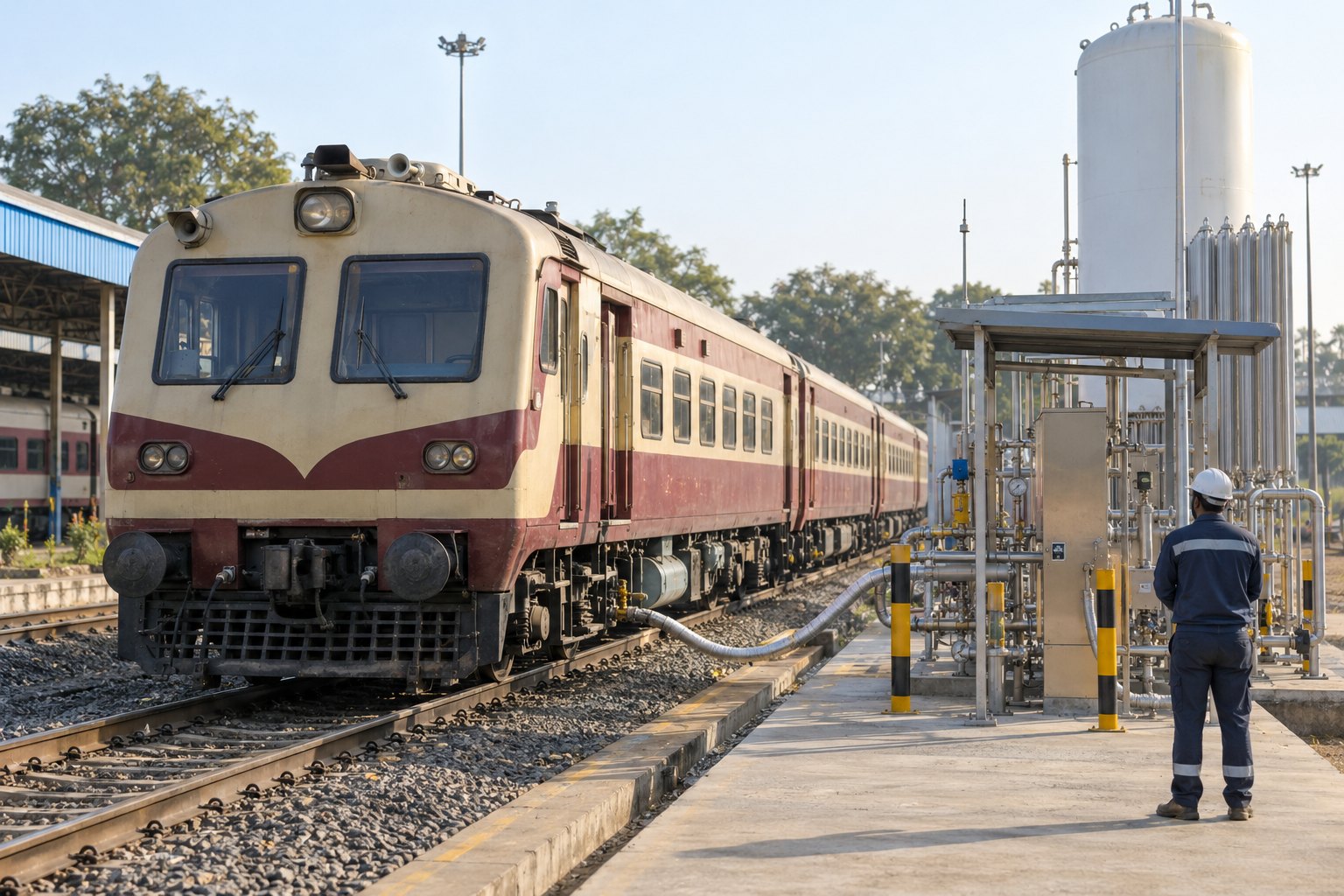
Home Minister Amit Shah flagged off India's first LNG–diesel dual-fuel DEMU at Sabarmati, Gujarat, on September 27. The eight-coach train runs on two 1,400 HP driving power cars converted at the Sabarmati Integrated Coaching Depot. LNG can replace about 40% of the diesel; from trial data, Railways estimates fuel savings of about Rs 23.9 lakh a year for the rake.
Syllabus: GS3 · Infrastructure; GS3 · Science & Technology; GS3 · Environment & Conservation
Why it matters
For a passenger, little changes: Railways says the dual-fuel system is designed to keep the engine's power and reliability. What changes is the fuel bill and the exhaust. LNG is cheaper than diesel, and swapping about 40% of the diesel for it is estimated to save about Rs 23.9 lakh a year on one eight-coach rake. Railways also expects lower emissions of carbon dioxide, nitrogen oxides and particulate matter. These are estimates from trials on two power cars. LNG is still a fossil fuel, so carbon dioxide still comes out of the exhaust; the hydrogen train's fuel cell gives off only water vapour. The larger issue is how Railways cuts the diesel it still burns, which Amit Shah put at 108 crore litres in 2024–25.
Prelims pointers
- DEMU (diesel-electric multiple unit): a self-propelled train set; a diesel engine in the driving power car generates electricity for traction motors, so no separate locomotive is needed.
- EMU (electric multiple unit): a self-propelled train set that collects power from the 25 kV AC overhead wire through a pantograph.
- LNG (liquefied natural gas): natural gas, mainly methane, cooled to about minus 162 degrees Celsius; its volume shrinks about 600 times.
- CNG (compressed natural gas) came first on DEMUs: a 2017 Railway Ministry release reported up to 20% of diesel replaced by CNG in dual-fuel 1,400 HP engines.
- India's first hydrogen train (Jind–Sonipat, July 17, 2026): a fuel cell combines hydrogen and oxygen to make electricity; water vapour is the only direct by-product.
- The hydrogen train has 10 coaches, two hydrogen driving power cars, a total output of 2,400 kW and lithium iron phosphate batteries.
- LNG use is expected to cut carbon dioxide, nitrogen oxides and particulate matter emissions compared with diesel alone.
Practise a UPSC-style question
Consider the following statements about India's first LNG-powered train, flagged off in September 2026:
1. It was flagged off from Sabarmati railway station in Gujarat and ran its inaugural trip to Mahesana Junction.
2. Its two driving power cars were converted to burn liquefied natural gas alongside diesel in the same engine.
3. Its dual-fuel system is designed to replace about 80 per cent of diesel consumption with liquefied natural gas.
Which of the statements given above is/are correct?
- (a) 1 and 2 only
- (b) 2 and 3 only
- (c) 1 and 3 only
- (d) 1, 2 and 3
Show the answer
Answer: (a) 1 and 2 only
1 is correct: Home Minister Amit Shah flagged it off at Sabarmati, Gujarat, on September 27, 2026, and the inaugural run was to Mahesana Junction. 2 is correct: two 1,400 HP driving power cars were converted to an LNG–diesel dual-fuel system, in which the same engine uses both fuels. 3 is incorrect: LNG can replace about 40 per cent of the diesel, not 80 per cent.
More from the 30 September 2026 edition
- Cabinet approves Green Energy Corridor Phase-III for intra-State lines and batteries Economy
- CDSCO warns against unsupervised use of painkillers and antibiotics Sci-Tech
- IRDAI proposes phased cuts to insurers' distribution cost limits Economy
- Centre notifies CAFE-III fuel-efficiency norms for passenger vehicles from 2027 Environment
- India proposes AIIB support for MSME technology adoption and skills Economy
- NGT orders joint panel to inspect encroachments at Sambhar Lake Environment