
Bagh caves, Sites of Satyagraha among five new UNESCO Tentative List entries
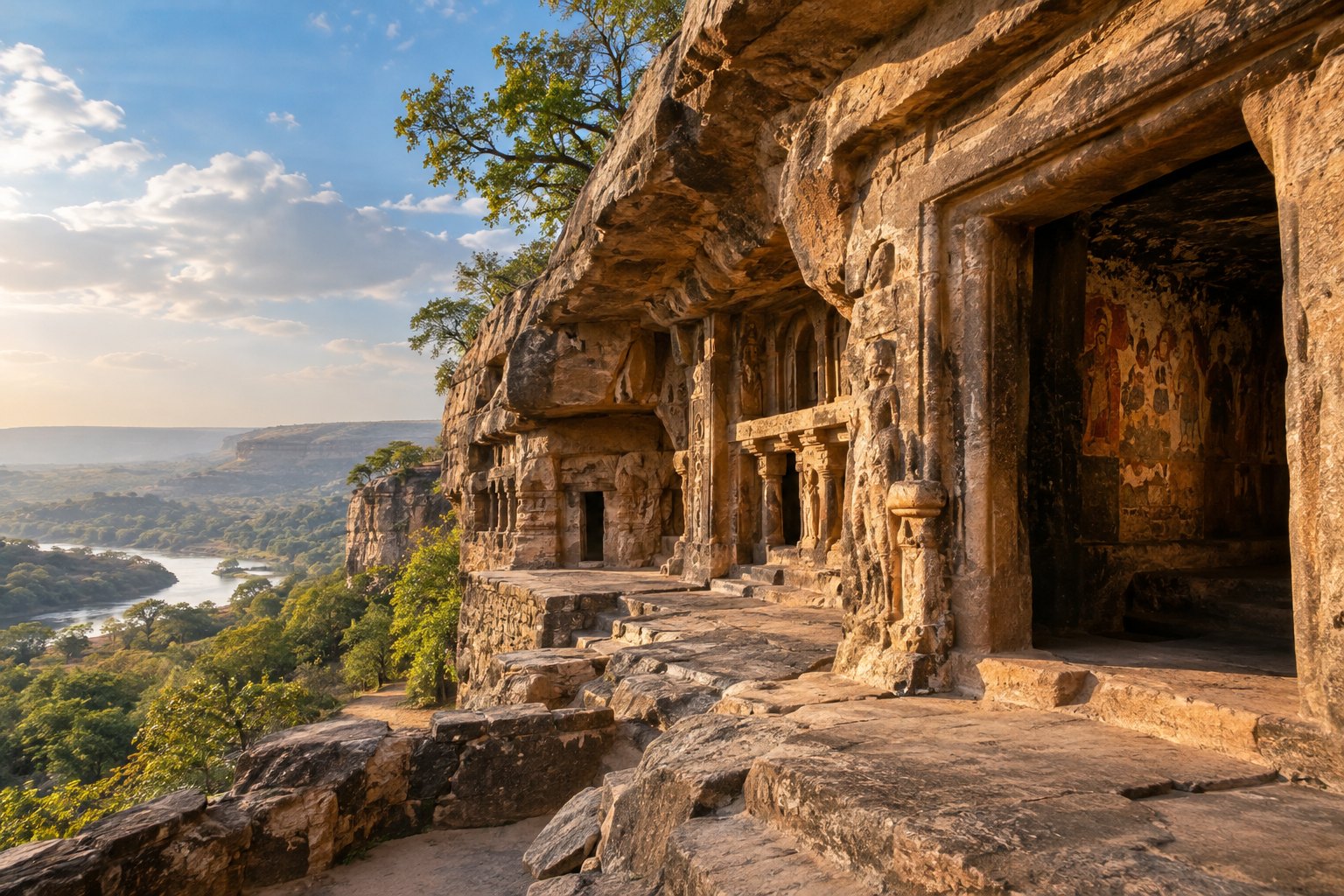
On 29 September 2026 the government announced five additions to India's UNESCO World Heritage Tentative List, taking it to 78 entries. Four are in Madhya Pradesh: the Bagh Cave Paintings, Chambal Valley temples, Udaigiri Caves and Ginnorgarh fort. The fifth, Sites of Satyagraha, is a joint serial proposal with South Africa. None is yet a World Heritage Site.
Syllabus: GS1 · Art & Culture; Prelims · History & Culture; GS1 · Freedom Struggle
Why it matters
For people living around Bagh, Udaigiri or Ginnorgarh, nothing changes at once: a Tentative List entry is a shortlist, not World Heritage status, and none of the five is yet a World Heritage Site. It opens the road. Each site now needs a Preliminary Assessment and then a full dossier, and the rules allow roughly one of each per country a year, so India's 78 entries queue for a slot. Inscription, when it comes, brings international attention, visitors and conservation duties. The choice also shapes how India presents its past: a Gond tribal capital, Buddhist murals, early Gupta shrines and a freedom-struggle story shared with South Africa.
Prelims pointers
- World Heritage Convention, 1972: adopted by UNESCO's General Conference in Paris; covers cultural and natural heritage in one treaty; India ratified it in 1977.
- Tentative List: a State Party's inventory of sites it intends to nominate (Article 11 of the Convention); no nomination is complete unless the site is already on it.
- Preliminary Assessment (2025 Operational Guidelines): a mandatory desk review by ICOMOS and IUCN as relevant, no site visit; it must precede a full dossier by at least a year.
- Advisory Bodies: ICOMOS (an NGO, France) evaluates cultural nominations; IUCN (Gland, Switzerland) natural ones; ICCROM (Rome) advises on conservation and training.
- World Heritage Committee: 21 States Parties elected by the General Assembly; meets once a year and decides inscription. Its secretariat is the World Heritage Centre, set up in 1992.
- Ten criteria for Outstanding Universal Value: (i) to (vi) cultural, (vii) to (x) natural. Sites of Satyagraha is proposed under criteria (iii) and (vi).
- Two Udayagiris: the Udayagiri caves near Vidisha are Gupta and mainly Brahmanical; the Udayagiri-Khandagiri caves near Bhubaneswar, Odisha, are Jain, with Kharavela's Hathigumpha inscription.
- Kachchhapaghatas also built the circular Chausath Yogini Temple, Mitaoli, in Morena district; it is not part of the Chambal temples proposal.
Practise a UPSC-style question
With reference to the World Heritage process under UNESCO, consider the following statements:
1. Evaluation of nominated cultural properties is carried out by the International Union for Conservation of Nature (IUCN).
2. A nomination dossier is not treated as complete unless the property is already on the State Party's Tentative List.
Which of the statements given above is/are correct?
- (a) 1 only
- (b) 2 only
- (c) Both 1 and 2
- (d) Neither 1 nor 2
Show the answer
Answer: (b) 2 only
1 is incorrect: the Operational Guidelines give the evaluation of cultural nominations to ICOMOS, the International Council on Monuments and Sites; IUCN evaluates natural ones. 2 is correct: the Guidelines treat a dossier as complete only when the site is already on the Tentative List (and, under the Guidelines since 2023, has had a Preliminary Assessment).